Wednesday, January 20, 2021

Wisdom from Fr. Wilfrid Stinissen


The definitive truth is also the definitive meaning. To accept or reject the Bible is therefore a decisive matter. Man’s destiny depends on it. If we reject the truth of the Bible, we reject life’s genuine, original meaning. Since no one can live without meaning, we are forced to create an artificial meaning and live in illusions.

— Fr. Wilfrid Stinissen

from his book The Word is Very Near You

2 Samuel 7:5


Go and tell your servant David, ‘Thus says the Lord: Would you build me a house to dwell in?’

— 2 Samuel 7:5

Wisdom from Dr. Scott Hahn


Christ, the firstborn of God, is sacrificed for us [...] He completes each and every aspect of the Passover—He takes it, and He perfects it. And this idea that we have to receive the Lamb all of a sudden falls right into place, and we understand it.

— Dr. Scott Hahn

from his book The Lamb's Supper

Sunday, January 10, 2021

The Baptism of the Lord, Cycle B Sunday, January 10, 2021


First Reading

Isaiah 55:1-11 (The first reading from Cycle A, Isaiah 42:1-4,6-7, may also be chosen.)
Isaiah calls upon the people to return to the Lord.

Responsorial Psalm
Isaiah 12:2-3,4-6 (The psalm from Cycle A, Psalm 29:1-4,9-10, may also be chosen.)
A prayer of praise for God's salvation.

Second Reading
1 John 5:1-9 (The second reading from Cycle A, Acts of the Apostles 10:34-38, may also be chosen.)
The Spirit of Truth testifies on behalf of Jesus, God's Son.

Gospel Reading
Mark 1:7-11
Jesus is baptized by John the Baptist.


Gospel Mk 1:7-11

This is what John the Baptist proclaimed: 
“One mightier than I is coming after me.
I am not worthy to stoop and loosen the thongs of his sandals.
I have baptized you with water; 
he will baptize you with the Holy Spirit.”

It happened in those days that Jesus came from Nazareth of Galilee 
and was baptized in the Jordan by John.
On coming up out of the water he saw the heavens being torn open 
and the Spirit, like a dove, descending upon him.
And a voice came from the heavens, 
“You are my beloved Son; with you I am well pleased.”


Background on the Gospel Reading

Today we celebrate the feast of the Baptism of the Lord. In most years, this feast is celebrated on the Sunday after Epiphany. When Epiphany falls on either January 7 or 8, the Baptism of the Lord is celebrated on the Monday after Epiphany.

In today's Gospel we hear John the Baptist contrast his baptism of repentance with the baptism that Jesus will inaugurate. John the Baptist says that he has baptized with water, but that the one who is to come will baptize with the Holy Spirit. John's baptism was not yet a Christian baptism; it was a preparation for the Christian Baptism we celebrate today, and through which sins are forgiven and the gift of the Holy Spirit is received. In accepting John's baptism, Jesus, though sinless, united himself with all sinners.

The baptism of Jesus is reported in each of the three Synoptic Gospels—Matthew, Mark, and Luke. Clearly, Jesus' baptism was an event of great significance for Jesus and for the early Christian community. Mark and Luke report the story from Jesus' perspective; the voice from heaven is addressed to Jesus. In Matthew's Gospel, the voice from heaven speaks to all who are present. The descent of the Holy Spirit on Jesus at his baptism shows that something new is beginning through the baptism and ministry of Jesus.

The baptism of Jesus is considered an important manifestation of God in the person of Jesus, another epiphany. Jesus' baptism inaugurates his mission. Mark's Gospel moves quickly from the report of Jesus' baptism to Jesus' temptations in the desert to his ministry in Galilee after John's arrest. The end of the ministry of John the Baptist is the beginning of Jesus' ministry. In an analogous way, our Baptism inaugurates our mission as Christians.

Surprisingly, on this the last day of the Christmas season the Gospel does not tell a story from Jesus' childhood. Instead the Gospel reveals Jesus' relationship to God: the Son of Mary and Joseph is also God's own Son. We believe that through Baptism we are also made children of God.


Family Connection

In the story of Jesus' baptism, we hear the report of a significant moment in Jesus' life. By accepting baptism from John the Baptist, Jesus shows himself to accept solidarity with sinners. In the voice from heaven and the descent of the Holy Spirit, we know that God received this offering from Jesus and found it pleasing. In the passages that follow in Mark's Gospel, we learn that Jesus' baptism marks the beginning of his public ministry.

Although many of us may have already taken down our Christmas decorations, liturgically speaking, the Christmas season hasn't ended yet; today is the last day. Holidays like Christmas are highlights of our year, moments of great grace. This grace renews us and prepares us for our return to the season of Ordinary Time, to the continuing work of discipleship.

Gather as a family and discuss your feelings about the ending of the Christmas season. How does it feel to take down the Christmas decorations? Many of us experience a letdown after the excitement of Christmas; others may feel relieved that life is returning to normal. Liturgically, we end the Christmas season today by reflecting on the importance of Jesus' baptism. Read together today's Gospel, Mark 1:7-11. Jesus' baptism prepared him for his public ministry. What will we take from this Christmas season to carry us forward into Ordinary Time, to renew and strengthen our life of Christian discipleship? Conclude by praying together today's psalm response taken from the book of the prophet Isaiah, Isaiah 12:2-6, or pray the Prayer to the Holy Spirit.


Sources: Loyola Press; Sunday Readings

Sunday, December 13, 2020

Third Sunday of Advent, Cycle B December 13, 2020

First Reading

Isaiah 61:1-2a,10-11
The Lord’s salvation will be made known to the poor and the oppressed.

Responsorial Psalm
Luke 1:46-50,53-54
Mary sings praise to God.

Second Reading
1 Thessalonians 5:16-24
Paul encourages the Thessalonians to rejoice and pray always.

Gospel Reading
John 1:6-8,19-28
John gives testimony that he is preaching and baptizing in order to prepare for the coming of another.


Gospel JN 1:6-8, 19-28

A man named John was sent from God.
He came for testimony, to testify to the light,
so that all might believe through him.
He was not the light,
but came to testify to the light.

And this is the testimony of John.
When the Jews from Jerusalem sent priests
and Levites to him
to ask him, “Who are you?”
He admitted and did not deny it,
but admitted, “I am not the Christ.”
So they asked him,
“What are you then? Are you Elijah?”
And he said, “I am not.”
“Are you the Prophet?”
He answered, “No.”
So they said to him,
“Who are you, so we can give an answer to those who sent us?
What do you have to say for yourself?”
He said:
“I am the voice of one crying out in the desert,
‘make straight the way of the Lord,
’”
as Isaiah the prophet said.”
Some Pharisees were also sent. 
They asked him,
“Why then do you baptize
if you are not the Christ or Elijah or the Prophet?”
John answered them,
“I baptize with water;
but there is one among you whom you do not recognize,
the one who is coming after me,
whose sandal strap I am not worthy to untie.”
This happened in Bethany across the Jordan,
where John was baptizing.


Background on the Gospel Reading

This Sunday’s Gospel invites us to continue our reflection on the person and mission of John the Baptist. Today we depart from the Gospel of Mark and read a selection from the Gospel of John.

The Gospel for today combines a brief passage from the prologue to John’s Gospel with a report about John the Baptist. As in Mark’s Gospel, the Gospel of John contains no birth narrative. Instead, John’s Gospel begins with a theological reflection that has come to be called the “prologue.” This prologue places the story of Jesus in its cosmological framework. It speaks of Jesus’ existence with God since the beginning of time. In John’s Gospel, Jesus is presented as the fulfillment of the Old Testament and the culmination of the Word, the light that is coming into the world’s darkness.

Following this prologue, John reports on the ministry of John the Baptist. We learn about the attention that John the Baptist received from the Jewish authorities. Messengers from the Jewish priests, the Levites and the Pharisees question John about his identity and the meaning of the baptisms that he is performing. John’s Gospel uses these questions to establish the relationship between Jesus and John the Baptist. John the Baptist is not the Messiah, nor is he Elijah or the Prophet. In John’s denials, we hear echoes of the kind of messianic expectations that were common in first-century Palestine.

The only affirmative response that John the Baptist gives is when he quotes the prophet Isaiah. Upon answering the next question, John announces that the savior they seek is already among them, but as yet unrecognized. John’s response highlights for us an important Advent theme: Jesus has already come into the world as our savior. During Advent, we pray that we will be able to recognize Jesus’ presence in our midst. Advent also reminds us that Jesus will come again to fulfill the promise of salvation. We pray that we will continue to be watchful as we anticipate that great day.

The third Sunday of Advent is also called Gaudete SundayGaudete, a Latin word which means “rejoice,” is taken from the entrance antiphon for Sunday’s Mass. This theme is echoed in today’s second reading from the first Letter to the Thessalonians. It is a reminder that Advent is a season of joy because our salvation is already at hand.


Family Connection

In family life, we learn to trust other people for protection and care. This experience of trust within the family enables children to believe us when we testify about our faith in Jesus. John the Baptist was believed by those who heard him because he helped them to recognize Jesus in their midst. In our family life, we hope and pray that we lead one another to recognize Jesus’ presence in our world.

As you gather as a family, recall that during the Advent season we are invited to pay particular attention to the signs of Jesus’ presence in our world. Consider some of the signs of Jesus’ presence that you have experienced. During Advent, we remember how John the Baptist prepared the way for Jesus. Read together today’s Gospel, John 1:6-8,19-28. Discuss the signs of Jesus’ presence in our world that you named and explain what these signs tell us about God and God’s love for us. Pray together that your family will be led to recognize that Jesus is present among us. Read and pray together the psalm for today’s Mass, the Magnificat (Luke 1:46-55).


Sources: Loyola Press; Sunday Readings

Wednesday, November 11, 2020

30% off Advent books!


Advent Sale!


Timely Books to Make
This Your Most Fruitful
Advent Yet!


Use promotion
code ADVENT30 to
receive 30% OFF
 your order.


Offer Expires:
 Tuesday 11/17 at midnight

SHOP NOW

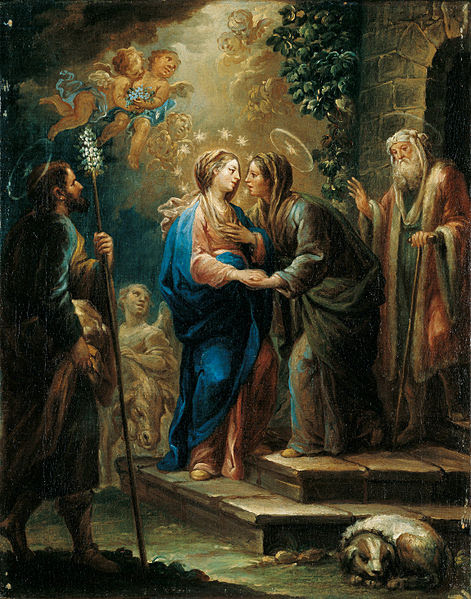
File:Jerónimo Ezquerra Visitation.jpg


Great Books for Advent:


Covering the Sunday Advent readings and events leading up to the birth of Jesus, these meditations carry you back to Bethlehem but take you earlier as well: to ancient Israel, where prophets foretold the coming of the Messiah. 


Spend Advent with Our Lady of Fatima and six saintly souls who were particularly devoted to her: St. Teresa of Calcutta, St. John Paul II, Fr. Andrew Apostoli, and the Three Shepherd Children to whom Mary appeared. Every day of Advent you'll read, reflect, pray and act. 
Discover lost Advent traditions detailed by Maria von Trapp including: how to make a your own Advent wreath; six Advent hymns; the traditions of Christkindl, Letter to the Holy Child, Advent Calendar; how to celebrate St. Barbara, St. Nicholas, and St. Thomas's Day; fourteen Advent themed recipes; and much more.


One meditative reflection for every day of Advent from one of the Church's greatest orators, Bishop Jacques-Bénigne Bossuet.

More Books for a
Fruitful Advent:


BUY NOW


Use promotion
code ADVENT30 to
receive 30% OFF
 your order.


Offer Expires:
 Tuesday 11/17 at midnight


Order online above, or call
1-800-888-9344


www.SophiaInstitute.com

Invite friends to
receive our newsletters
and get these books
for FREE!
LEARN MORE

Get one discounted book
per month—and never
pay shipping!

Learn more: